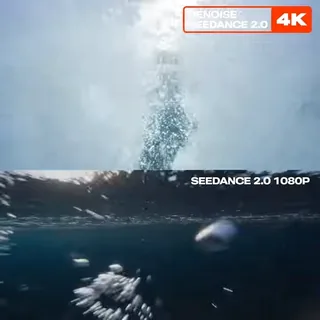
National Geographic Wildlife Documentary, IMAX cinematic quality, 4K Ultra HD, photorealistic underwater cinematography, ultra-macro high-speed underwater fly-through, 240fps slow motion combined with rapid forward motion, volumetric light scattering, dynamic depth-parallax movement, scientifically inspired microscopic marine ecosystem visualization.
[Biological Subjects (Critical)]
Bioluminescent plankton
Baby jellyfish (gelatinous body, translucent bell shape, transparent anatomy)
Cilia protozoa (microscopic microorganisms with rapidly moving hair-like cilia)
[00:00–00:02] Shot 1: Fast Dive In
The camera rapidly plunges beneath the ocean surface.
The water surface instantly fractures into shimmering sheets of refracted light as the camera breaks through.
Streams of bubbles and suspended particles rush upward past the lens at high speed.
Scattered bioluminescent plankton begin appearing at the edges of the frame, glowing as isolated blue-white points of light within the dark water.
Volumetric light rays penetrate from above, creating layered shafts of illumination through the descending water column.
[00:02–00:05] Shot 2: Plankton Flow Field
The camera enters a dense plankton layer.
Thousands of bioluminescent plankton drift with ocean currents, forming ribbon-like streams of glowing particles.
Microscopic cilia protozoa move rapidly through the fluid environment, their hair-like cilia oscillating continuously and creating flowing cloud-like formations.
Water currents stretch individual light sources into elongated luminous trails.
Suspended particles sweep past the camera, enhancing the sensation of scale and speed within the microscopic world.
[00:05–00:07] Shot 3: Jellyfish Corridor
The camera flies through a corridor of transparent baby jellyfish.
Their translucent bell-shaped bodies pulse rhythmically, contracting and expanding to propel themselves through the water.
Each contraction generates delicate circular vortices that ripple outward into the surrounding fluid.
Soft blue bioluminescence flickers inside their gelatinous bodies with every pulse.
The camera rapidly weaves between individual jellyfish, creating dramatic foreground depth stretching and strong parallax motion.
[00:07–00:09] Shot 4: Bioluminescent Surge Zone
The surrounding plankton population suddenly emits synchronized bioluminescence.
A wave-like pulse of blue-white light propagates through the water, illuminating the entire microscopic environment.
Complex biological structures and suspended microorganisms become visible within the expanding glow.
As bubbles pass through the luminous field, they generate rainbow-like refractive dispersion and spectral light splitting.
The entire scene transforms into a living ocean of pulsing light.
[00:09–00:10] Shot 5: Micro Light Core Pass
The camera accelerates into the brightest concentration of bioluminescent organisms.
The glowing plankton organize into a swirling microscopic vortex of light.
Countless organisms spiral around a luminous center, resembling a miniature nebula suspended underwater.
Depth layers rotate around the core while streams of light converge inward.
Final moment: the camera bursts through the center of the vortex.
An intense white flash fills the frame, freezing at peak brightness as the sequence ends.