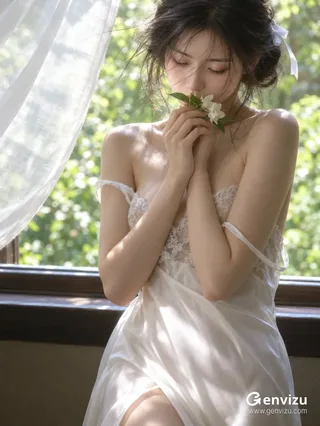
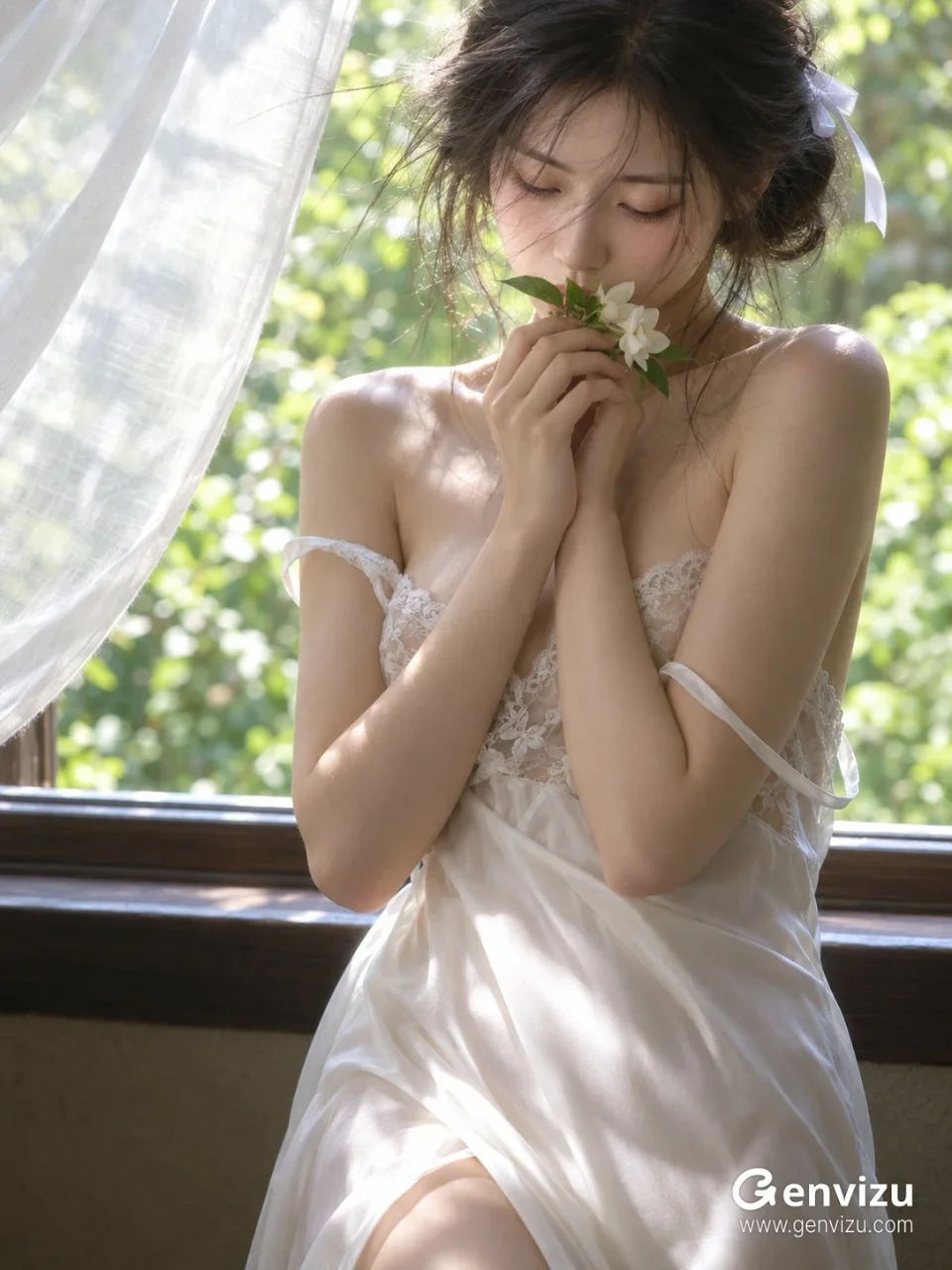
Create one photorealistic editorial portrait of a new fictional 21-year-old adult East Asian woman standing close to an open garden-facing window, gently smelling a small white blossom. The image is intimate, airy, quietly absorbed and unmistakably adult, with a slender adult frame, moderately narrow relaxed shoulders and natural head-to-shoulder proportions. Use a vertical 3:4 composition, closely framed from the softly gathered crown of her hair to her upper thighs. The woman dominates the frame, slightly right of center. Keep the flower, both hands, bent elbows, shoulders and the draping ivory dress readable within the portrait. Generate the composition naturally at this ratio without stretching the subject or expanding into a distant room.
Her face is a softly tapered oval with rounded cheek transitions, a small but anatomically mature chin, gently straight brows, delicate almond-shaped eyes, a modest straight nose and softly defined rose-colored lips with a rounded lower lip and subtle cupid's bow. Give this fictional woman her own identity: the cheek and jaw transitions, eye spacing and lip contour should feel individual rather than a stock glamour face. Her head is tilted down and a little toward the left side of the picture. Her eyelids are lowered almost closed as she attends to the flower; her expression is calm and inward, without a broad smile or a direct camera gaze. The mouth rests naturally just behind a leaf and the stem, not exaggerated into a pout. Preserve the quiet relationship of downcast eyes, lowered chin and the flower raised close beneath her nose. The visible skin should have soft natural warmth, fine pores and tiny tonal variations, lightly refined but never waxy, uniformly white or aggressively sharpened.
Her dark brown-black hair is loosely swept up into a soft, low, irregular gathered style with rounded rolls beside the ears and a small loosened bun behind. The hairline and part are partly obscured by airy windblown strands; a soft off-center sweep is enough, without a hard center seam. Wisps cross the forehead, the eyes, the nose and the cheek, creating fine semitransparent lines in the light rather than hiding the whole face. Leave slightly different individual strands and a believable asymmetrical arrangement. A small pale lavender-white ribbon sits behind the hair on the right side of the image, with two light narrow tails. It is a restrained domestic detail, not a large bridal ornament. Keep the crown full and loosely arranged, with natural flyaways and no helmet-like polish.
She holds one small creamy white flower and its short green stem near her lips and nose. Its soft layered petals open toward the right side of the image beside her raised shoulder, with several small dark green leaves interrupting the line below her nose. Both hands gather lightly around the short stem and near each other, with relaxed tapered fingers and short natural nails. The near hand overlaps the other hand only where physically plausible; distinguish finger roots, knuckles and fingertips and keep the grip gentle. Her forearms fold diagonally inward across her chest, forming a compact sheltered shape. The elbow on the left side of the picture falls lower, and the opposite bent elbow makes a soft rounded corner closer to the middle. One shoulder rises slightly with the bent arm and the head tilts toward it; this is a natural self-contained posture, not a rigid shrug. Trace each forearm continuously into its wrist and upper arm; retain two arms and two hands with anatomically coherent overlap. Do not add extra limbs, flowers, doubled fingers or a hand disconnected behind the blossom.
The dress is an ivory satin slip with a delicate floral lace upper panel, a softly curved neckline and fine narrow straps. One strap rests low at the upper arm on the left side of the image, while the other forms a loose ribbon-like curve around the upper arm on the right. Preserve these light straps as continuous fabric elements with clear attachments, not as tight bands or extra jewelry. Lace remains lace: fine floral threads and small open mesh details along the trim, delicate rather than heavy embroidery. The central bust area is softly backed with matching ivory fabric for non-explicit coverage, without making the whole garment thick or replacing the lace texture. The satin falls away below the fitted upper edge into gentle vertical and oblique folds. The lower dress remains opaque, with broad pearly highlights and soft gray-green reflected shadows. It should look like a simple lived-in slip, not a corseted wedding gown, a formal evening dress or an enlarged plunging neckline. Keep the adult body proportionate and slender without extreme waist cinching, exaggerated breasts or shoulders, or childlike proportions. The mild curvature is explained by the folded arms, three-quarter torso turn, fabric drape and light, not by distortion or exposed intimate anatomy.
A translucent white curtain billows from the upper left corner toward the middle-left edge, framing her without covering the hands or face. Its softly woven fibers, long folds and gently bright edge are visible. Behind her, the window looks out onto sunlit green foliage reduced to layered soft shapes and small light patches. A dark wooden horizontal sill crosses behind her around lower-elbow height and anchors the otherwise airy composition. Only a narrow quiet wall area is visible below it. Keep the garden blurred and believable; avoid distinct landmarks, legible signs, text, added decor or invented location cues. The small flower remains the only held object.
Lighting comes from strong garden daylight through the window and the moving translucent curtain. Let diffuse pale daylight illuminate the left side of the face and the exposed shoulder planes, with soft broken bands of leaf-and-curtain shadow across the shoulder, upper arm and satin. The hair has subtle rim-lit flyaways but a rich dark mass. Keep the face softly shaded enough to retain cheek and nose volume. Green foliage provides a restrained reflected tint in the shadows, balanced by warm natural skin and ivory fabric. Make the luminous curtain and garden bright without blowing out the flower petals or satin. Avoid a studio flash look, evenly painted illumination, cyan-white skin, artificial orange grading or overly hard shadow stripes. Light and shadow must correspond to the window, curtain, leaf shapes and body planes.
Use an intimate portrait viewpoint near upper-chest to eye height, a natural moderate portrait perspective, and a gentle three-quarter view. The face, flower and hand contact occupy the central upper portion; the crossing forearms guide the eye down toward the satin folds. Preserve a small breathing margin around the bent elbows while keeping the subject close. Focus should resolve the near eyelashes, fine stray hair, flower edges, lace threads and finger joints, with soft optical falloff into the garden and lower fabric. Use fine restrained photographic grain and a subtle luminous softness while retaining actual detail. No illustration, plastic skin, beauty-filter face, oversaturated greens, added text, logos, borders or watermark. The final feeling is a private moment of smelling a flower beside an open window: soft moving air, relaxed adult anatomy, realistic material contrast and a calm, unforced expression.
更多提示
http://
genvizu.com
https://
genvizu.com