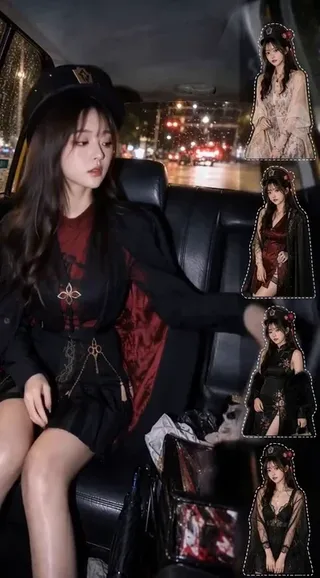
integrated_multimodal_description: For the target video, at 0.00 seconds into the target video, <Picture 1> is fully referenced. <Subject 1> is the exact same subject shown in <Picture 1>. Use <Picture 1> as the sole and complete visual authority for identity, face, body, hairstyle, hat, accessories, taxi interior, rainy night street outside the windows, lighting, composition, color, and all other visible attributes. The video begins from the exact physical and visual state contained in <Picture 1>: the character is seated in the back seat of a taxi at night, wearing the starting outfit (black coat, burgundy top, black skirt with gold patterns, black socks). On the right side of the frame, a vertical UI panel displays 4 dashed white-framed garment preview thumbnails, stacked top to bottom. The 4 UI thumbnails are static previews — they remain still and do not animate or act independently.
Fast-paced dress-up sequence. The character stays seated throughout the entire video. She reaches toward the 4 UI frames on the right side, one at a time, in strict order from top to bottom, physically taking each outfit out of its frame and putting it on, with fast uniform rhythm.
Core rule — this is the single most important constraint of the entire video: the moment she takes an outfit out of a UI frame and puts it on, her entire outfit becomes exactly the garment shown inside that frame. The garment in that UI thumbnail and the garment now on her body are the same garment — identical color, identical fabric, identical cut, identical style, identical pattern, identical length, identical every visible detail. Not similar. Not inspired by. Identical. After an outfit is taken from its frame, that frame briefly dims or shows a used/empty state to confirm it has been taken.
Take sequence:
- Take from the top frame (frame 1, pale pink sheer long dress with floral pattern) → her outfit becomes that exact pale pink sheer floral dress. Frame 1 shows used state.
- Take from the second frame (frame 2, burgundy satin deep-V short dress with black sheer shawl) → her outfit becomes that exact burgundy satin dress with black shawl. Frame 2 shows used state.
- Take from the third frame (frame 3, black sleeveless qipao with floral embroidery, holding a black fur handbag) → her outfit becomes that exact black floral qipao, and she holds the black fur handbag. Frame 3 shows used state.
- Take from the bottom frame (frame 4, black lace deep-V sheer dress with transparent long sleeves) → her outfit becomes that exact black lace sheer dress. Frame 4 shows used state.
After the 4th outfit is taken and worn, all 4 frames show used state. The character adjusts her posture slightly and holds a confident, clear seated presentation pose in the final black lace outfit, holding this pose for the remaining duration of the video.
Camera: fixed vertical shot matching the exact composition of <Picture 1>. Both the seated character and the right-side UI panel stay clearly and fully visible at all times — this is essential so the correspondence between each taken outfit frame and the garment worn by the character is always visually verifiable. No cuts. No camera movement except an extremely subtle push-in of no more than 5 percent, or one soft flash frame, at each take-and-change moment, after which the camera immediately returns to the exact fixed framing. No wide shots, no orbiting, no angle changes, no panning.
No singing, no lip-sync, no dialogue, no new people, no additional props beyond what is visible in <Picture 1>, no weapons, no added garments beyond the 4 UI options, no redesign of the character or the UI, no change to the taxi environment, no change to the rainy night background, no face beautification, no anatomy alteration, no body proportion alteration, no gradual costume morph, no taking the same outfit twice, no outfit that does not exactly match its corresponding UI frame, no UI frames remaining full at the end, no dramatic camera movement, no 360 orbit, no wide-shot pull-out, no shot that obscures the UI or the character's body during a change, no background replacement, no teleporting.
overall_soundscape: Clean, minimal interaction and costume-change sound effects only. Each time she reaches and takes an outfit from a frame, a soft fabric-grab or pickup sound plays. Each outfit change is accompanied by a quick whoosh or shimmer sound effect lasting no more than 0.3 seconds, timed exactly to the moment she puts it on. The final presentation pose is marked by a single bright ding or chime sound. Very low-volume rainy city ambience from outside the taxi windows may be present at a subtle level. No loud footsteps, no prominent environmental noise.
non_diegetic_music: A light, upbeat, rhythmic background track at a steady tempo of approximately 120 to 128 BPM that supports the fast uniform take-and-change rhythm. Clear downbeats align with each take moment. The mood is playful and game-like but not overpowering — the music supports the outfit taking and costume changes rather than competing with them. The final pose may include a small musical flourish or resolution.